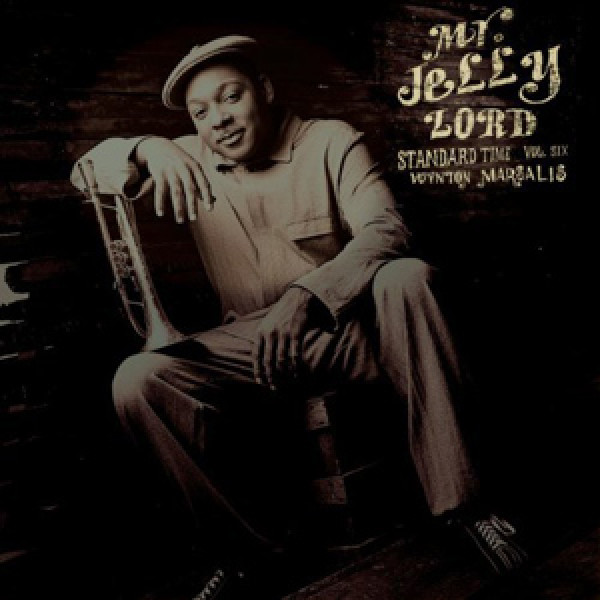
Mr. Jelly Lord - Standard Time Vol. 6

TRACK LIST

01.Listen Red Hot Peppers

02.Listen New Orleans Bump

03.Listen King Porter Stomp

04.Listen The Pearls

05.Listen Deep Creek

06.Listen Mamanita

07.Listen Sidewalk Blues

08.Listen Jungle Blues

09.Listen Big Lip Blues

10.Listen Dead Man Blues

11.Listen Smoke House Blues

12.Listen Billy Goat Stomp

13.Listen Courthouse Bump

14.Listen Black Bottom Stomp

15.Listen Tom Cat Blues

buy CD on Music Today
buy on iTunes Music Store
SIDEMAN
Eric Lewis (piano), Eric Reed (piano), Danilo Perez (piano), Reginald Veal (bass), Victor Goines (tenor and soprano saxophones), Wessell Anderson (alto saxophone), Wycliffe Gordon (trombone), Lucian Barbarin (TROMBONE), Ronald Westray (TROMBONE), Victor Goines (CLARINET), Michael White (CLARINET Harry Connick Jr. (PIANO), Herlin Riley (DRUMS)

DESCRIPTION
Fifteen classic stomps and blues by Jelly Roll Morton, including “King Porter Stomp” and “The Pearls,” give Wynton the opportunity to demonstrate that the music of this New Orleans jazz pioneer remains as modern as tomorrow. Wynton performs here with fellow New Orleans natives Kent Jordan (flute), Reginald Veal (bass), Herlin Riley (drums), Don Vappie (banjo), and Harry Connick, Jr. (piano). And don’t miss Wynton’s duet with pianist Eric Reed on “Tom Cat Blues,” recorded on the same sort of wax cylinder equipment that Jelly Roll Morton used on his first recordings in the early years of the 20th century.

LINER NOTES
All Jazz is Modern:
The Music of Mr. Jelly Lord

Of this, his latest effort, Wynton Marsalis says, “I wanted to, once again, reiterate the contemporary power of even the earliest jazz. Jelly Roll Morton’s music proves that all jazz is modern. His music captures the full range of New Orleans life. Jelly Roll Morton’s music, however, still applies to the New Orleans of today. It is dated neither in form nor feeling.”

“In New Orleans, we still play funerals and parades, we still have blues clubs, and we still have the same easy, poetic attitude toward the carnal. We still have the willingness, if the wrong thing is said at the wrong time, to sink all the way back to those ways that underlie the wild side of our reputation. Jelly Roll Morton knew all of that, and the music he wrote and spent so much time meticulously teaching his musicians, has grooves, emotions and forms that exist for the purpose of expressing those powerful New Orleans artistic sensibilities.”

“That is why I have always enjoyed playing Jelly Roll Morton’s music over the last twenty years. It has taught me a great deal about the meaning of jazz and it always refreshes your understanding of how timeless art is. What makes something art is that it’s true for the time in which it existed and remains true in the times that follow. Whenever you endeavor to play the music of Mr. Morton correctly, you discover that what he was doing is just as strong now as it was when he created it. His compositions tell the story of the eternal New Orleans, which is the eternal human story, the timeless thing that jazz musicians express when they master blues and swing.”

“In or out of jazz, there has never been a major composer who was quite like, or even near, Jelly Roll Morton. Morton was something. He had just about every kind of bad quality a human being could have and just about every trait necessary to prove himself a genius. He was a braggart; he was racially prejudiced; he sold poisonous snake oil door to door; he was a pool shark; he was a pimp; he was a sharp shooter, and he was a man who believed in his art as much as any great artist of any idiom has ever believed in the aesthetic form of choice.”

“He was the first who had serious theories about jazz, and all of them were correct. As much of a street thug, hustler, and self-promoter as he might have been, Morton was the initial intellectual to enter the music. His impact was profound, whether it was on those he taught to play as he rambled from state to state or those such as Duke Ellington. All were indelibly touched. Morton understood how form should be manipulated and he recognized the importance of dynamic shifts and improvisations to intensify the quality of compositions. There was a rather direct relationship between his music and his life. Our first great composer of jazz had an epic sense of life. He played in parades, hung out in after-hours joints where the high and the low class gathered to pursue joy. His piano provided the live soundtrack for whorehouse erotic melodramas. He heard the most primitive blues sung by New Orleans dock workers. The worst side of the criminal life was familiar to him and Morton also spoke of women belting out the blues from their doorways. He heard that music of the opera and the symphony and recognized that jazz should contain the best elements of the musical gutbucket as well as the technical penthouse. The mixed parentage of jazz was obvious and it was Morton who recognized the essential significance of riffs and of the Afro-Hispanic rhythms he called “the Spanish tinge.”

Wynton Marsalis, who is easily the most gifted and the most sophisticated musician of his generation, has brought together young musicians to play his music just as someone in the European idiom would bring young musicians together to play the music of the Eighteenth Century, and for the same reason. When you get into the profound, those who started it all or put the first serious refinements on it, or foresaw what could be done by doing everything possible at the time, you not only instruct those performers in ways that will influence whatever they do in whatever style, you also reiterate the fact that in human terms there is no past, only a present when it comes to art. This is what this recording is all about. Here you will witness just how well musician, who have no problems addressing the sweep of their art, perform the work of Jelly Roll Morton. From the clarity of the ensembles to the wring of the group, to the precision, wit, lyricism, and fire of their improvisations, they achieve victories of the very same quality that they do when Marsalis and his players address any kind of jazz, whether basic, in the middle or all the way out of the frontier where blues and swing are given extraordinary reinterpretations. Here, with the same kind of authority Kenneth Branaugh brought to his Henry V. Much Ado About Nothing, and Hamlet, they let us know that old and new are only as meaningful as the material and the artists who give it life or fail to do so. In this case, life brims up out of every note, just as Mr. Jelly Lord intended.

–Stanley Crouch

REVIEWS
Orange County Register - September 17, 1999

Wynton Marsalis
Mr. Jelly Lord
(Columbia)

This latest entry in trumpeter Wynton Marsalis’ ambitious series of eight CD releases leading up to the millennium is a stunner. Marsalis has always been enthusiastic about music with New Orleans roots, and this is his finest release to date in that vein.
Much of the disc’s success is due, of course, to the material. The music of Jelly Roll Morton is historically important, deeply inventive and, more than anything, fun. All those qualities shine in this 15-cut collection. A lot of the numbers are familiar (”King Porter Stomp,” “Black Bottom Stomp,”), but they are rendered by Marsalis and company with a vivid freshness and warm sincerity.
The instrumentation is, at first glance, very traditional, consisting of varying combinations of trumpet, trombone (Lucien Barbarin and Wycliffe Gordon), tuba (Gordon), clarinet (Michael White and Victor Goines) and banjo (Donald Vappie). The rhythm section is made up of Eric Reed, Danilo Perez, Eric Lewis or Harry Connick Jr. on piano, Reggie Veal on bass and drummer Herlin Riley. But the approach often is more in a modern vein.
The presence, for instance, of regular Marsalis cohorts Wes Anderson, on alto sax, and Goines doing double duty on tenor and soprano bring some surprising results. This is especially evident on “The Pearls,” with the sax work running stylistically counter to the rest of the ensemble - but never actually clashing.
What you’ll enjoy here is a sense of fun, even on blues numbers. The raspy trombone tone on “Jungle Blues,” for instance, will make you think you’ve blown a speaker. And Marsalis can growl with the best of them, as evidenced on “New Orleans Bump.” The whole disc, in fact, is peppered with the leader’s “laughing” horn sounds. But when playing straight, as on “Deep Creek,” Marsalis’ mastery cannot be doubted.
The final cut, “Tom Cat Blues,” is a bit of a bonus and an amusing stunt. Marsalis and Reed recorded it at the historic Edison Laboratory in New Jersey - using the same horn-and-stylus technology from Morton’s era. The results are interesting, but will have the listener down on his or her knees, thankful for digital technology and cheap CD players.

–Steve Eddy

——————————————

Billboard - September 18, 1999

Wynton Marsalis
Mr. Jelly Lord
(Columbia)

Who better than Wynton Marsalis to lead a yearlong interpretive survey of this century’s jazz masterpieces, along with an ambitious program of original recordings that reflect on a broad range of classical and popular music? The trumpet player, composer, educator, bandleader, and musical ambassador is as well steeped in these genres as any other musician, musicologist, or scholar. The series, titled Swinging Into The 21st Century features a wide palette of releases, including Thelonious Monk- and Stravinsky- inspired titles, plus Marsalis originals ranging from film music to live recordings to a modern ballet suite. But the highlight is Vol. 6, a heartfelt and enlightened tribute to jazz pioneer Jelly Roll Morton. It features Marsalis leading a band that includes pianist Eric Lewis, drummer Herlin Riley, and bassist Reginald Veal, with guest appearances from pianists Danilo Perez, Harry Connick, Jr. and Eric Reed. A recording that possesses a rare combination of state-of-the-art sound quality and soul, Mr. Jelly Lord closes with a version of “Tom Cat Blues” recorded using an early Edison cylinder device. A wonderful album that showcases Morton’s groundbreaking music and Marsalis’ unique gift for bringing it to light.

——————————————–

Jazz Times - February 2000

Wynton Marsalis
Mr. Jelly Lord
(Columbia)

Wynton Marsalis appears to have been as prolific a recording studio denizen as was his late mentor, Miles Davis. So apparently overcrowded are the Columbia vaults with Marsalis sessions that Wynton is concluding an unprecedented blitz of seven recordings in seven months, including suites, standards and homage dates. Mr. Jelly Lord falls in the latter category as Marsalis leads 12 members of his broadening crew of familiars through 15 gems Jelly Roll Morton left here for us to learn. Befitting the historic importance, not to mention self-importance of Mr. Jelly Lord, as the iconoclastic, brilliant, often profane Morton was known, the music is addressed by no fewer than four very divergent pianists: Eric Lewis, Eric Reed, Danilo Perez, and Harry Connick, Jr.
As the tracks wend their way through familiar bits of Morton’s repertoire like “Red Hot Pepper”, “King Porter Stomp”, and “The Pearls”, alternated with lesser-knowns like “Sidewalk Blues” and “Dead Man Blues”, the impression that Marsalis has invested considerable time digging through Morton’s muse is clear. And thankfully the band does not address Jelly’s music as period pieces, but on Wynton’s own terms; not as deconstructionist, but as reverent update. Hewing to the tradition of this music, while giving it a contemporary polish is no small feat, yet it is accomplished here with aplomb. Hear, for example, his spare arrangement of “King Porter Stomp” - muted trumpet with piano accompaniment, achieving a relaxed and soulful approach to the classic.

–Willard Jenkins