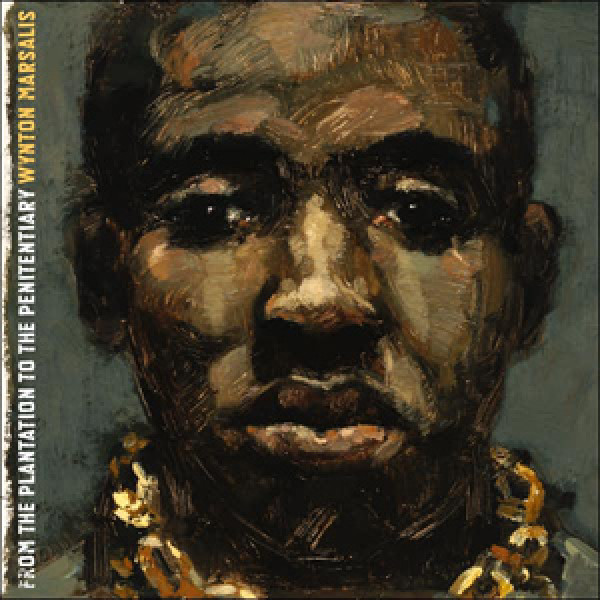
From the Plantation to the Penitentiary
Track list
01.Listen From The Plantation to the Penitentiary
02.Listen Find Me
03.Listen Doin’ Our Thing
04.Listen Love And Broken Hearts
05.Listen Super Capitalism
06.Listen These Are Those Soulful Days
07.Listen Where Y’All At?
Digital Booklet and lyrics
(download PDF - 1.4 mb)

Walter Blanding (tenor & soprano saxophones), Jennifer Sanon (vocals), Dan Nimmer (piano), Carlos Henriquez (bass), Ali Jackson (drums)
DESCRIPTION
By turns soothing, urgent, playful, and angry, From the Plantation to the Penitentiary distills Marsalis’ recent observations on our modern American way of life as he’s traveled the nation as a performer, teacher, and private citizen. Through the sultry alto of 21-year old singer Jennifer Sanon, he gives voice to the “tattered ragmen” of America in Find Me, rebukes our misogynistic entertainment industry- “I ain’t no bitch and I ain’t your ho”- in The Return of Romance, and denounces the uncontrolled financial exploitation of modern America in which “there’s never enough” in the frantic Super Capitalism. The most striking track on the album is Where Y’all At?, a rare spoken-word vocal performance by Marsalis, in which he demands to know what’s happened to all the responsible leaders in America- Where y’all at?
The album has its bright moments as well: the languid These Are Those Soulful Days was inspired by the diehard, bicoastal friendship between his 10-year old son and Walter Blanding’s 11-year old twin daughters that these three have maintained almost since birth, while the bouncy and soulful instrumental Doin Our Thing lets Marsalis and his band interpret various types of 4/4 grooves anchored, of course, by the swing.
The seven tracks on the album are all new compositions, with lyrics and music by Wynton Marsalis. Walter Blanding (reeds), Dan Nimmer (piano), Carlos Henriquez (bass), and Ali Jackson (drums) round out the Wynton Marsalis quintet.
LINER NOTES
CAN YOU SEE?
Art evolves with society and is informed by society, but an artist should never be so intimidated by the need for social acceptance that he or she will change the personal discovery of a vital truth just to fit in with vaporous trends. But sometimes the vapor of a trend is as rooted in poisoned gas as bigotry is rooted in brutal superstition. Sometimes, as the New Orleans legend Buddy Bolden is supposed to have said, all we have to do is open up the windows and let the bad air out. Nothing quite so simple can be done with superstition because it will not, like gas, rise up and float away when wind is allowed in through the window and bad air is ushered out. Some artists compose and perform as though they will continue to open up the window, no matter how that opening is responded to, whether with acceptance or rejection.
Wynton Marsalis is one of the most important artists of our moment because the quality and range of his talent has few peers and his integrity is exceeded by no one. (Uh oh: did I hear somebody say integrity in this house?) Like Bolden, this contemporary son of New Orleans made a name for himself by “calling the children home.” Marsalis reestablished the power and elegance of jazz in his time and for his generation and for all generations that came before or after his. This has now been going on for over twenty years and it was no small achievement when it began and the opposition to what Marsalis went after was met both with great acceptance and great rejection. None of that stopped him from going his own way and from carrying much of the jazz world with him.
There were still problems because it sometimes seems to many that the balance achieved by integrity is impossible; the consequence is that the very idea of equilibrium starts to take on the form of a bitter myth due to the stubborn certitude of the protean opposition, which is almost as wily and flexible as art itself. One strain of opposition has evolved from the condition that began in 1619 when twenty African slaves arrived in Jamestown, Virginia. Neither those slaves nor anyone else knew that plantation bondage would last for over two hundred years and that 600,000 people would have to die in a bloody civil war before the slaves were freed into an ambiguous fate. That’s how hard-headed the opposition to abolition was.
That is also why the certainty of inevitable freedom was made clear in the only way it could by Abraham Lincoln, the commander in chief during that civil war. In his Second Inaugural Address, the president of the United States expressed the heroic and collective sense of democracy that he knew was the only solution. No, Lincoln did not bite his tongue on March 4, 1865 when he said,“Fondly do we hope, fervently do we pray, that this mighty scourge of war may speedily pass away. Yet, if God wills that it continue until all the wealth piled by the bondsman’s two hundred and fifty years of unrequited toil shall be sunk, and until every drop of blood drawn with the lash shall be paid by another drawn with the sword, as was said three thousand years ago, so still it must be said ‘the judgments of the Lord are true and righteous altogether.’ ”
The level of collective commitment made clear by Lincoln is what we need today, across all lines of political and ethnic distinction, because far too many of the descendants of those chattel now live in a variation on plantation life that has become a national presence so pernicious that it inspired the title track of this recording. We must remember, however, that the blues awaits us all. It never fails to tell us that the ultimate truth is simple while complex: good and evil dance so closely together that they could easily become one–but never do! They simply coexist in perpetuity. The proportions of that coexistence are always left up to us. Those proportions are questioned throughout this recording and something lyrical and soulful is always responding to the sorrows and the difficulties, good dancing with evil while doing its best to step on the feet of the blues.
As usual Marsalis continues to prove his preeminence as a trumpet player and a leader of men, this time bringing along a new singer that he is as proud of as he is of the remarkable instrumentalists who move on up to higher ground with him. From their moving position on the hill, the air is quite clear and you can see everything you need to see. Some of it is horrible but it is taken on by the beautiful, and the battle is something to behold.
Stanley Crouch
REVIEWS
Marsalis blasts political and societal inequities
By Howard Reich
Tribune arts critic
Published March 4, 2007
For those who think of Wynton Marsalis as a purveyor of gauzy romantic ballads and composer of epic symphonic works, the trumpeter has a surprise in store.
“From the Plantation to the Penitentiary,” to be released Tuesday on Blue Note Records, ranks as Marsalis’ most explicitly political statement to date, even as it draws on themes from earlier recordings.
By obliquely calling President George W. Bush a “blunderbuss,” indicting gangsta rap as a culture of “killing and freakin’” and asserting that “the left and the right got the country sinkin’,” Marsalis has fashioned his latest recording as something of a cultural manifesto.
His most acerbic social criticism, including the aforementioned examples, emerges in the album’s bitter, climactic finale, a self-styled chant called “Where Y’All At.” Delivering his text as if from the pulpit — above a New Orleans backbeat — Marsalis decries ineffectual ’60s radicals, would-be revolutionaries, Republicans, Democrats, CNN, Fox News and practically the entire red-versus-blue culture in which we live.
More targets
His voice often hoarse and nearly shouting, his hurried phrases practically tumbling one onto the next, the trumpeter sounds angrier and more impassioned than even in the early days of his career, more than 20 years ago. Back then, he drew critical fire for lambasting rock and rap and other facets of American youth culture.
Now his range of targets has grown wider.
Though “Where Y’All At” may sound as if it’s some kind of political diatribe, it actually represents the natural conclusion to an album that slowly and inexorably lays out its case, before reaching its startling final minutes.
From its title track, which opens the recording, Marsalis bemoans how American life — and African-American life — has devolved from emancipation to the present day.
“From the plantation to the penitentiary, from the `yas-suh boss’ to the ghetto minstrelsy,” singer Jennifer Sanon cries in the opening track, above a vamping, chain-gang rhythm.
“From the work-long days to the dope and drinking craze,” she continues, “from the stock in slaves to the prison building trade.”
Practically every track that follows builds on the motif of a culture tragically in decline.
In “Find Me,” Sanon laments homeless souls “roaming the streets night and day.” In “Love and Broken Hearts,” she quotes misogynous vulgarities common to gangsta rap, then whispers: “It’s time for the return of romance, it’s time for you and me to slow dance.”
If Marsalis’ text is more detailed than ever in chronicling his view of our society’s shortcomings, it shouldn’t catch listeners totally unaware, if only because these themes long have been nascent in his work.
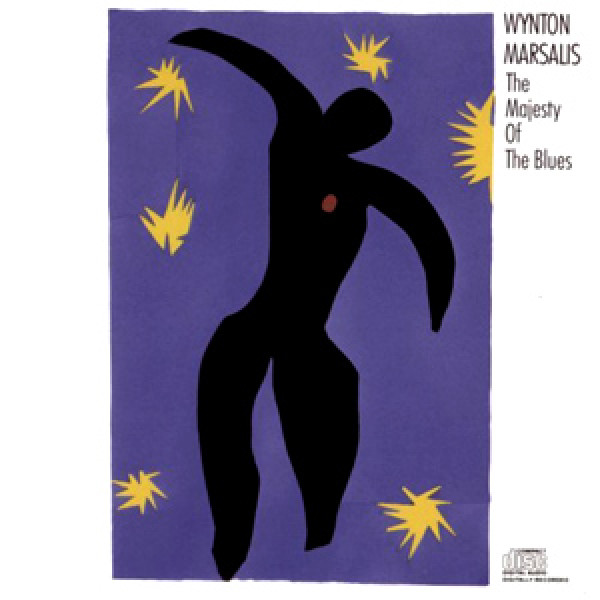
In the sprawling “Blood on the Fields,” which won Marsalis a Pulitzer Prize in 1997, the composer chillingly evoked the genocidal horrors of American slavery. Even in his first great album, “The Majesty of the Blues,” of 1989, an entire movement unfolds as a vast sermon on the nobility of jazz in America’s brazenly commercial musical culture (the text was written by essayist Stanley Crouch).
Now, however, Marsalis has named names, yet he has done so within the context of a steeped-in-blue score that enhances the power of his message.
Innocence
Certainly in choosing Sanon to deliver all the lyrics except the finale, Marsalis has found an unusually disarming artist to give voice to his ideas. Using scant vibrato and unfurling her lines without ornamentation or artifice, Sanon brings a youthful innocence to the proceedings that even skeptical listeners may find difficult to resist.
More important, Marsalis has used his instrumental quintet so that it sounds larger than it might seem, evoking the sound of his more famous septet of the 1980s and early ’90s (still the best group he ever led). In effect, its azure colorings, incantatory rhythms and romantic yearnings represent the antithesis of the modern-day culture Marsalis condemns.
No doubt the tough-talking stance of his CD will not be welcomed by everyone, yet Marsalis surely has taken pains to create a melodically inspired, rhythmically alluring album that stands on its own as a work of music — even apart from its flame-throwing lyrics.
With saxophonist Walter Blanding often suggesting the spirit of John Coltrane on saxophones and Marsalis producing characteristically poetic solos on trumpet, “From the Plantation to the Penitentiary” reaffirms Marsalis’ unique position as jazz virtuoso and cultural commentator.
It also proves that, in the right hands, political discourse can swing.
—————————————
Steve Jones, USA Today
March 5, 2007
Wynton Marsalis, From the Plantation to the Penitentiary: * * * *
Politicized jazz
Marsalis has used his music to make political statements in the past, but never has he been this explicit. Here the New Orleans native unleashes potent post-Katrina ventings about everything from the callous government to the crass entertainment industry. He laments the coarsening of American culture and the avarice of American capitalism. Singer Jennifer Staton often gives voice to these concerns, while Marsalis lets his trumpet do the talking. But on the pointed Where Y’all At?, Marsalis speaks, and nobody (including himself) escapes blame for the troubles he sees.
—————————————
Music Review: Wynton Sounds Off
By CHARLES J. GANS, Associated Press Writer
Tuesday, March 6, 2007
Wynton Marsalis, “From the Plantation to the Penitentiary” (Blue Note): Wynton Marsalis pulls no punches on his first CD since Hurricane Katrina devastated his hometown, offering seven new compositions with a sharp-edged commentary on the state of American society and culture. The opening track, “From the Plantation to the Penitentiary,” contains some of the jazz trumpeter’s most powerful lyrics, lamenting how black Americans have gone from one form of slavery to another - “From the stock in slaves/To the booming prison trade” - marked by broken families and long drug-related sentences. Drummer Ali Jackson, Jr. evokes images of lashing whips and rattling chains and Marsalis plays a fiery, impassioned solo, but 21-year-old vocalist Jennifer Sanon lacks the rawer emotional edge to fully pull the song off. Sanon, who has a bright future, is better suited to the romantic ballad, “Love and Broken Hearts,” in which Marsalis strikingly juxtaposes her sweet voice with his edgy lyrics criticizing misogynistic gangsta rap - “Oh safari seekers and thug life coons/ You modern day minstrels and your songless tunes” - while longing for “the return of romance.” Marsalis’ new quintet - with the underrated saxophonist Walter Blanding and newcomers Dan Nimmer (piano) Carlos Henriquez (bass) - adeptly handles the leader’s challenging compositions, such as the instrumental “Doin’ (Y)our Thing” with its shifting grooves. Marsalis’ lyrics are less effective on such tunes as “Supercapitalism,” a critique of rampant American consumerism. The message seems a bit disingenuous coming from a messenger who’s pitched luxury goods and received large corporate donations to create his Jazz at Lincoln Center venue in that capitalist mecca, the Time Warner Center. Marsalis takes a rare vocal turn on the closing “Where Y’all At?” shouting out rapid-fire couplets over a funky New Orleans beat as he takes to task rappers, ’60s liberal activists and political leaders for not matching their rhetoric with action to fix America’s problems. Jazz mixed with a political message is nothing new, exemplified by the 1960 album “We Insist! Max Roach’s Freedom Now Suite.” But that album, featuring Abbey Lincoln’s vocals and lyrics by Oscar Brown, Jr., only underscores the uneven quality of Marsalis’ latest effort. Marsalis’ abilities as a lyricist do not match his prowess as a composer, but this is still a thought-provoking CD meriting attention.