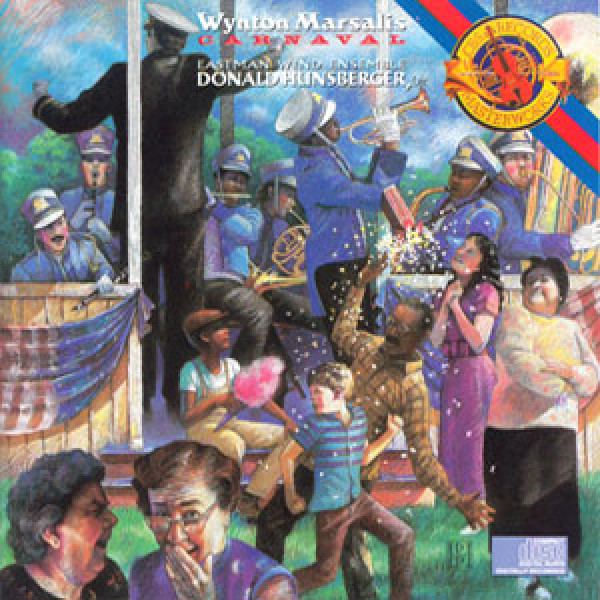
Carnaval
01.Listen Variations sur Le Carnaval de Venise
02.Listen The Debutante (Caprice brillant)
03.Listen Believe Me, If All Those Endearing Young Charms
04.Listen Grand Russian Fantasia
05.Listen Moto Perpetuo, Op. 11
06.Listen Tis the last Rose of Summer
07.Listen The Flight of the Bumblebee from Tsar Saltan
08.Listen Napoli - Variations on a Neapolitan Song
09.Listen Fantaisie Brillante
10.Listen Sometime I feel Like a Motherless Child
11.Listen Valse Brillante (Sounds from the Hudson)

Eastman Wind Ensemble (wind ensemble), Donald Hunsberger (conductor)
DESCRIPTION
The acclaimed Eastman Wind Ensemble, conducted by Donald Hunsberger, features Wynton’s sparkling cornet work in a program that includes music by Rimsky-Korsakov, Niccolo Paganini, Jean-Baptiste Arban (whose “Variations on ‘Carnival in Venice’ ” inspired the album’s title and typifies its buoyant mood), Herbert F. Clarke, Jules Levi, and the 18th century Irish composer Thomas Moore.
LINER NOTES
Around the turn of the twentieth century, the wind band was the primary medium for average Americans to hear music performed live. Bands were everywhere. Community ensembles were found in every size city and town; numerous industries and military regiments fostered band activity. Millions flocked to the amusement parks, state and industrial expositions and to local theaters to hear professional ensembles—directed by such luminaries as John Philip Sousa, Patrick S. Gilmore, Frederick Innes and Arthur Pryor—performing programs of marches, orchestral and operatic transcriptions, light-hearted incidental music, and, especially, to hear the numerous soloists featured on each concert.
The distinguished lineage of cornet soloists performing throughout America from the end of the Civil War through the 1920s included Gilmore, Matthew Arbuckle, Jules Levy, Ben Bent, Alessandro Liberati, Hermann Bellstedt, Herbert L. Clarke, Walter Emerson, Frank L. Simon, Edna White and Louise Horn. Many of these performers went on to found and direct their own professional bands.
The cornet was an outgrowth of technical developments emanating from the addition of valves to the natural trumpet. The design of the cornet, basically a conical bore instrument versus the cylindrical bore of the trumpet, provides it with a mellow, warm, rounded sound as opposed to the brilliance or cutting edge of the orchestral valved trumpet. It earned itself a position of prominence in wind bands and brass bands where music was written primarily in flat keys (versus the sharp keys that favor the string instruments in an orchestra) and where the sweeter sound of the instrument provided a satisfactory treble melodic line. Indeed, the principal requirements for a cornet solo included gracious melodic lines, simple harmonies and strong clear rhythms set in patterns that alternated the soloists with the accompanying band. The band would be featured in the introduction and in the “break strains,” short passages of contrasting material that set-up the soloists for his (or her) next variation or statement. In addition, cornetists performed encores that dazzled the audience with technical proficiency or lulled them into a sense of rapture through the sheer simplicity and beauty of a lovely slow melody presented in a warm singing manner. In this collection Wynton Marsalis performs three such slow, enchanting melodies.
Wynton possesses the same unique abilities to cross over the performance lines between various styles and techniques of performance that made the soloists listed above outstanding among their contemporaries. His technical command of the instrument is truly phenomenal in its consistency, resulting in dazzling displays of rapid tonguing and slurring. All this, however, is balanced by the warm melodic interpretive sense with which he approaches the music. The ability to continue performing while breathing (rotary or circular breathing) enables Wynton to continue melodic lines long past the time one would expect the air supply to diminish!
–Donald Hunsberger
REVIEWS
Here, Wynton Marsalis switches to cornet and tries to recreate the ambience of the proverbial village wind bands of long ago albeit with the emphatically big-league help of Donald Hunsberger and the massive Eastman Wind Ensemble. This means a program of transcriptions of classical tunes, variations on popular ditties, dollops of sentimentality, heaping amounts of showoff display figurations, and other stuff that used to go over big in Middle America in the days before radio and electrical recording came in. From the hoary old hurdy-gurdy tune “The Carnival of Venice” that leads off the album onward, this is a record for dedicated antiquarians who dote on their Edison band cylinders because they like the music. But Marsalis works earnestly with the idea, playing those insidiously hummable tunes absolutely straight, with acres of flawless rapid-fire technical displays and even a touch of soulfulness on the token spiritual, “Sometimes I Feel Like a Motherless Child.” And Marsalis’ pass through the nonstop minefield of Paganini’s Moto Perpetuo, using circular breathing to make the dumbfounded listener think that he doesn’t have to take a breath, is a pretty astounding technical feat.
- Richard S. Ginell
All Music Guide